Present progressive
Present progressive: forms
am/are/is + -ing
- I am waiting.
- Are you listening?
- She isn’t working today.
For spelling of -ing forms, (see here).
For passive forms (e.g. The work is being done), (see here).
Use: ‘around now’
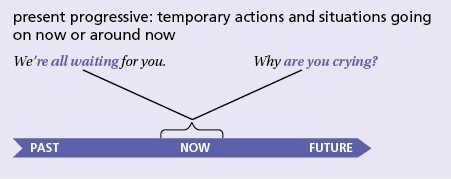
We use the present progressive to talk about temporary situations that are going on now or ‘around now’: before, during and after the moment of speaking.
- Hurry up! We’re all waiting for you! (not
We all wait …) - ‘What are you doing?’ ‘I’m writing emails.’ (not
… I write emails.) - He’s working in Saudi Arabia at the moment.
Repeated actions
The present progressive can refer to repeated actions and events, if these are just happening around the present (for more details, (see here).
- Why is he hitting the dog?
- I’m travelling a lot these days.
Changes
We also use the present progressive to talk about developments and changes.
- That child’s getting bigger every day.
- House prices are going up again.
Talking about the future
We often use the present progressive to talk about the future (see here).
- What are you doing tomorrow evening?
- Come and see us next week if you’re passing through London.
Things that happen all the time: present progressive not used
We do not normally use the present progressive to talk about permanent situations, or about things that happen regularly, repeatedly or all the time. Compare:
- Look – the cat’s eating your breakfast!
‘What do bears eat?’ ‘Everything.’ (not‘What are bears eating? …’) - Why is that girl standing on the table?
Chetford Castle stands on a hill outside the town. (not… is standing …) - My sister’s living at home for the moment.
Your parents live in North London, don’t they?
Verbs not generally used in progressive forms
Some verbs are not generally used in progressive forms (see here), even if the meaning is ‘just around now’.
- I like this wine. (not
I’m liking this wine.) - Do you believe what he says? (not
Are you believing …?) - The tank contains about 7,000 litres at the moment.
how long? present tenses not used
We use a perfect tense, not a present tense, to say how long something has been going on. (see here) for details.)
- I’ve been learning English for years. (not
I’m learning English for years.)