Simple present: use
General time: It always rains in November.
We often use the simple present to talk about timeless truths, permanent situations, or things that happen regularly, repeatedly or all the time.
- What do frogs eat? (not
What are frogs eating?) - Alice works for an insurance company.
- It always rains here in November.
- I play tennis every Wednesday.
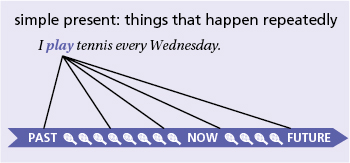
Not used for things happening just around the present
We do not usually use the simple present to talk about temporary situations or actions that are only going on around the present. Compare:
- Water boils at 100° Celsius.
The kettle’s boiling – shall I make tea? (notThe kettle boils …) - It usually snows in January.
Look – it’s snowing! (notLook – it snows!) - I play tennis every Wednesday.
‘Where’s Bernard?’ ‘He’s playing tennis.’ (not… He plays tennis.)
Non-progressive verbs
However, the simple present is used for this ‘around the present’ meaning with verbs that do not usually have progressive forms (see here).
- I like this wine. (not
I’m liking …) - I believe you. (not
I’m believing you.)
Talking about the future
We do not normally use the simple present to talk about the future.
- I promise I won’t smoke any more. (not
I promise I don’t smoke …) (see here) - We’re going to the theatre this evening. (not
We go to the theatre this evening.) - ‘There’s the doorbell.’ ‘I’ll get it.’ (not
I get it.) (see here)
However, the simple present is used for ‘timetabled’ future events (see here).
- His train arrives at 11.46.
- I start my new job tomorrow.
And the simple present is often used instead of will … in subordinate clauses that refer to the future. (For details, (see here).)
- I’ll kill anybody who touches my things. (not
… who will touch …) - I’ll phone you when I get home. (not
… when I’ll get home.)
The simple present is also used in suggestions with Why don’t you …?
- Why don’t you take a day off tomorrow?
Series of events: demonstrations, commentaries, instructions, stories
When we talk about a series of completed actions and events, we often use the simple present. This happens, for example, in demonstrations, commentaries, instructions and present-tense stories (see here) for more details).
- First I take a bowl and break two eggs into it. (not
First I am taking …) - Lydiard passes to Taylor, Taylor shoots – and it’s a goal!
- ‘How do I get to the station?’ ‘You go straight on until you come to the traffic lights, then you turn left, ….’
- So I go into the office, and I see this man, and he says to me …
how long? present tenses not used
We use a perfect tense, not a present tense, to say how long a present action or situation has been going on. (see here) for details.)
- I’ve known her since 1990. (not
I know her since 1990.)